How to Connect Google Gemini to Dropbox
A Gemini Dropbox integration links Google Gemini models to Dropbox cloud repositories, allowing multimodal agents to analyze documents, spreadsheets, and media without manual file re-uploads. While Google Gemini lacks native Dropbox extensions, teams can sync Dropbox folders into an intelligent Fast.io workspace and query indexed files through remote Model Context Protocol (MCP) endpoints.


Connecting Google Gemini to Dropbox: The Integration Challenge
In a benchmark published on 9 September 2026, where every session ran through each provider's native connector in Claude Cowork, an agent running a multi-document audit completed a 211-file analysis through Fastio in 2 minutes and 50 seconds across 29 connector calls, compared to 4 minutes and 24 seconds across 115 calls for Dropbox. The benchmark method line notes: "Multi-document audit, single run per provider, 9 September 2026. Coverage counts the 12 ground-truth facts reported. A trap is handled when the brief used the correct version or disclosed the problem. Precision verifies every checkable claim against the PDFs. Fabrications are counted separately." Fastio completed the audit with zero unreadable document errors, while Dropbox had 4 unreadable files (including the scanned credit memo).
A Gemini Dropbox integration links Google Gemini models to Dropbox cloud repositories, allowing multimodal agents to analyze documents, spreadsheets, and media without manual file re-uploads. In modern business operations, knowledge workers rarely store corporate records inside a single repository. Marketing teams keep creative briefs, video footage, and brand assets in Dropbox. Legal counsels maintain supplier contracts and amendments across shared team folders. Finance departments store quarterly receipts, billing spreadsheets, and disbursement records in cloud drives. Organizing these distributed documents inside shared workspaces gives both human staff and Gemini agents a unified grounding foundation.
When developers deploy Google Gemini models, such as Gemini 1.5 Pro, Gemini 2.0 Flash, or Gemini 2.5 Pro, they need these models to reason over operational assets stored across the company. An auditor reviewing vendor agreements must examine contracts, invoices, and credit memos stored in Dropbox. Connecting these files to Gemini should provide instant answers backed by document citations.
However, Google Gemini does not provide a native bridge to Dropbox. The consumer Gemini web interface provides extensions for Google Workspace tools like Google Drive, Docs, and Gmail. In enterprise environments, Google Drive data store connections in Gemini Enterprise allow direct retrieval of information from Google Drive. Yet Google Gemini web interface features zero native extensions for Dropbox storage, requiring manual file attachment or external workspace synchronization.
Forcing teams to manually download files from Dropbox and re-upload them into Gemini chat windows creates immediate operational friction. Manual uploads break version control, expose sensitive data to local downloads, and fail completely for automated workflows. Building custom point-to-point scripts against raw storage APIs introduces rate limits and tool call sprawl. Teams standardized on Dropbox need a reliable, programmatic way to connect Gemini models to their files.
Why Traversing Raw Dropbox Folders Breaks Down for Autonomous Agents
Autonomous agents interact with cloud storage differently than human chat users. A person can wait for a single document download or pick two specific files from a file selector. An autonomous Gemini agent executing a research or auditing task must discover unknown information across deep directory trees. Pointing an agent directly at raw Dropbox endpoints creates technical bottlenecks that degrade speed and inflate inference costs. Many organizations evaluating a Dropbox alternative for AI agent infrastructure discover that traditional file storage is optimized for human browsing rather than high-frequency programmatic retrieval.
Recursive Directory Crawling and Tool Call Sprawl
The directory structures of enterprise organizations use nested folder hierarchies arranged by business unit, client, fiscal year, and project. Raw storage endpoints are engineered for human navigation rather than automated semantic discovery. When a Gemini agent must answer questions across a direct Dropbox connector, it cannot query the full document set at once.
Instead, the model must crawl the directory tree step by step. The agent calls folder listing endpoints, parses returned paths, evaluates candidate file names, and downloads files one by one. In the 211-file multi-document audit benchmark, this exploratory crawling drove 115 separate connector calls for Dropbox, taking 4 minutes and 24 seconds. Finding three relevant clauses across twenty files consumed dozens of round-trip network requests. Each additional tool invocation introduces latency, burns execution budget, and increases the chance of request timeouts.
API Throttling and HTTP 429 Errors
The Dropbox API enforces rate limits on calls issued over time on a per-authorization basis. According to the Dropbox Performance Guide, applications that exceed these thresholds receive an HTTP 429 error along with a Retry-After header indicating how many seconds the client must wait.
In an autonomous agent execution loop, receiving an HTTP 429 response halts progress. The agent must back off repeatedly, stretching tasks that should take seconds into multi-minute delays, or failing completely when pipeline timeout limits expire.
Context Window Bloat and Retrieval Dilution
The expansive context windows of frontier Gemini models can process over one million tokens. However, using context capacity as a substitute for indexed retrieval carries severe practical drawbacks. Passing entire 80-page Master Services Agreements and bulky vendor addenda into a prompt wastes input tokens and drives up inference expenses.
Context dilution directly degrades reasoning accuracy. When prompts become saturated with boilerplate legal terms, corporate disclaimers, and irrelevant appendices, a model's ability to locate precise operational details declines. Large token payloads also increase time-to-first-token latency, making agent interactions sluggish. Delivering concise, pre-indexed excerpts preserves context cleanliness and produces higher answer fidelity.
Unparsed Scanned Documents and Missing OCR
The scanned paper contracts, signed PDF amendments, delivery receipts, and invoices common in enterprise archives present severe challenges. Standard cloud drive APIs treat these files as opaque binary streams. When an agent requests an image-only PDF through a direct connector, the API returns raw binary data without extracting text characters.
In the 9 September 2026 multi-document audit benchmark, this blind spot caused Dropbox to fail on 4 documents. Essential facts remained unread by the inspecting agent. Without automated optical character recognition during file ingestion, direct storage connections cannot deliver complete document coverage.
Performance Comparison: Direct Connector vs Indexed Workspace
The structural differences between direct API traversal and indexed workspace retrieval explain why direct connectors struggle during complex agentic workflows:
Three-Step Gemini Dropbox Architecture Using Fastio Workspace Sync
The recommended path to connect Google Gemini to Dropbox preserves Dropbox as your primary system of record while using an intelligent Fastio workspace as the retrieval substrate. Rather than pulling whole folders into context or rewriting storage architecture, teams sync Dropbox directories into Fastio and query them through remote Model Context Protocol (MCP) endpoints.
1. Connect Dropbox Storage via Cloud Sync
The architecture begins by establishing a connection between Dropbox and Fastio using Cloud Import and scheduled folder synchronization. Fastio supports cloud synchronization for Dropbox, Box, and OneDrive (one-way or two-way, on a recurring schedule or on demand; never real-time). Google Drive imports files today, with sync coming soon.
In a typical agent deployment, administrators configure a one-way read-only sync from specific Dropbox project folders into a designated Fastio workspace. This setup ensures that source documents in Dropbox remain untouched. Team members continue creating, editing, and sharing files in Dropbox as usual. Fastio mirrors the folder structure and pulls updated files on schedule without requiring local desktop sync clients or consuming local disk space.
2. Automated File Ingestion, OCR, and Hybrid Indexing
When files enter the Fastio workspace, workspace Intelligence automatically parses and indexes every document. Unlike commodity cloud storage that stores files as dormant binary blobs, Fastio prepares documents for immediate agent reasoning.
Automatic OCR Processing: Fastio extracts text layers from scanned PDFs, photographed receipts, and images during ingestion. Text from scanned documents becomes searchable alongside digital documents.
Hybrid Search Indexing: Fastio builds dual indices across file contents and metadata, combining exact full-text matching with semantic vector retrieval. Gemini can locate exact contract numbers, clause titles, or conceptual queries without requiring an external vector database.
Structured Extraction with Metadata Views: For documents like invoices, purchase orders, and legal agreements, teams can define Metadata Views to turn unstructured files into typed, queryable data grids. Metadata Views extract typed values (Text, Integer, Decimal, Boolean, URL, JSON, Date & Time) without manual templates or OCR configuration.
3. Expose the Workspace via Remote MCP
When files are indexed, the Fastio workspace exposes a consolidated MCP toolset over Streamable HTTP at https://mcp.fast.io/mcp (or https://mcp.fast.io/mcp/key when using bearer token authentication).
Gemini models connect to this remote endpoint using standard MCP tooling. When Gemini needs to verify a billing discrepancy or extract contract milestones, it executes targeted search actions against the workspace index. The tool returns relevant text excerpts, page citations, and extracted metadata in a single turn, eliminating directory crawling and context bloat.
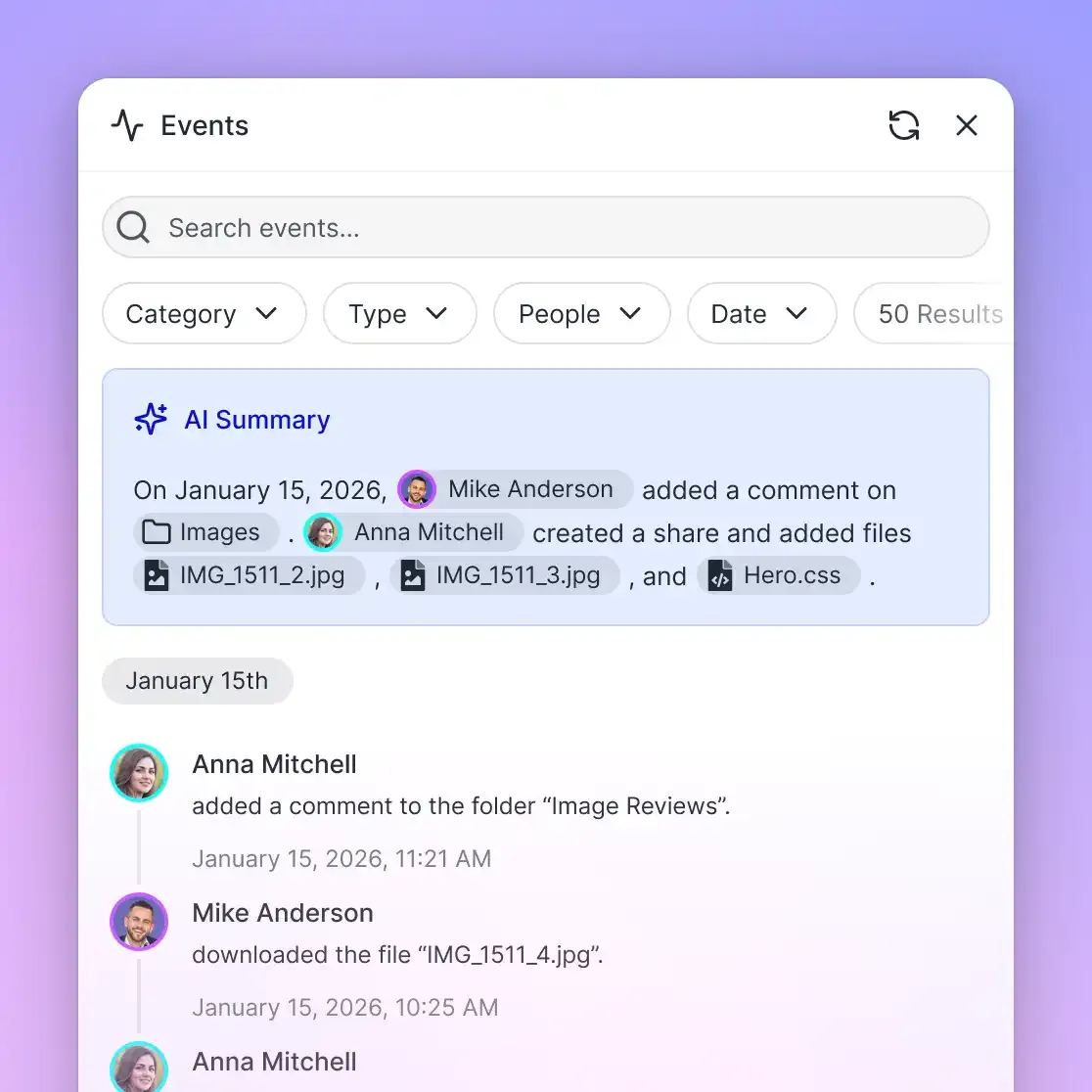


Connect Google Gemini to Dropbox with Intelligent Workspaces
Sync your Dropbox storage into an indexed workspace to give Gemini agents hybrid search, automated OCR, and page-level citations. Starts with a 14-day free trial.
Configuring Gemini to Query Dropbox Files via MCP and REST
Integrating Google Gemini with an indexed Fastio workspace requires registering the remote MCP server in your agent configuration or invoking search endpoints from Python or Node.js scripts.
Client MCP Configuration
For agent runtimes and developer tools supporting Model Context Protocol configurations, register Fastio as a remote Streamable HTTP server:
{
  "mcpServers": {
    "fastio": {
      "url": "https://mcp.fast.io/mcp/key",
      "headers": {
        "Authorization": "Bearer YOUR_FASTIO_API_KEY"
      }
    }
  }
}
The Fastio MCP server is fully remote and hosted at https://mcp.fast.io/mcp. It does not require installing local packages or starting background processes. Developers can review connection details on the storage for agents documentation page.
MCP Tool Call Execution
When an agent receives a prompt requiring factual evidence from synced Dropbox files, Gemini uses the Fastio storage search tool (see mcp.fast.io/skill.md) to search for "indemnification liability cap intellectual property warranty" across the synced workspace.
Fastio executes hybrid search across the indexed Dropbox documents and returns exact matching passages with citation metadata:
{
  "results": [
    {
      "name": "Master_Services_Agreement_2026.pdf",
      "path": "/commercial-agreements/Master_Services_Agreement_2026.pdf",
      "page_number": 14,
      "matching_text": "Supplier liability under Section 8 shall be capped at total fees paid during the preceding twelve months, excluding gross negligence or breach of confidentiality.",
      "score": 0.94
    },
    {
      "name": "Vendor_Statement_of_Work.pdf",
      "path": "/vendor-schedules/Vendor_Statement_of_Work.pdf",
      "page_number": 3,
      "matching_text": "Warranty terms extend for ninety days following milestone acceptance by customer.",
      "score": 0.89
    }
  ]
}
REST API Search Integration
For custom Python or Node.js workflows without an MCP client, developers can invoke Fastio search endpoints directly using standard HTTP libraries, as detailed in the Fast.io API documentation:
curl -X GET "https://api.fast.io/current/workspace/ws_apex_dropbox_sync/storage/search/?search=indemnification+liability+cap" \
  -H "Authorization: Bearer $FASTIO_API_KEY"
The search response delivers the same filtered text snippets and citations directly into your application code, ready to be injected into a Gemini generateContent request.
Structured Document Extraction with Metadata Views
When working with repetitive business records, such as supplier invoices or commercial leases, unstructured text search can be paired with structured data extraction.
Using Fastio Metadata Views, teams define extraction schemas in plain English. For example, describing columns for vendor name, invoice total, due date, and tax identifier prompts Fastio to extract typed values from incoming Dropbox documents automatically. Agents can query these structured columns directly via MCP actions or REST queries, filtering records before performing analytical synthesis.
Production Workflows: Permissions, Versioning, and Human-Agent Handoff
Moving a Gemini Dropbox integration into production requires operational discipline around security boundaries, version tracking, and collaboration between autonomous models and human colleagues.
Granular Access Controls and Workspace Isolation
The directory trees of enterprise Dropbox accounts contain sensitive human resources records, financial ledgers, and confidential strategy decks that should not be exposed to general agent queries.
Fastio provides granular permission controls across organizations, workspaces, folders, and individual files. When configuring Cloud Sync, map only specific, project-relevant Dropbox folders to the workspace where your Gemini agent operates. This workspace boundary prevents the agent from inspecting unauthorized company files. Agents authenticate using scoped API keys, ensuring that automated routines operate strictly within permitted directories.
Managing File Version History
The records in active business repositories change frequently. Suppliers submit revised rate cards, legal teams redline draft agreements, and marketing managers update campaign schedules.
When updated files sync from Dropbox to Fastio, Fastio preserves full per-file version history. The agent always inspects the latest version while retaining access to historical iterations. If an audit requires comparing terms across contract revisions, Gemini can query specific versions to identify changed wording.
Collaborative Notes for Agent-to-Human Delivery
For effective production pipelines, agents do not operate in a vacuum. Once a Gemini model analyzes a collection of Dropbox documents, human reviewers must inspect the findings, verify citations, and make operational decisions.
Fastio Collaborative Notes provides real-time co-editing where humans and agents work as first-class collaborators. A Gemini agent can write audit summaries, contract checklists, or risk assessments directly into a shared note within the workspace. Human teammates view the note, click cited passages to inspect source documents in the built-in file viewer, and finalize approvals without leaving the workspace.
Activity Feeds and Long-Polling
To monitor changes without hammering Dropbox endpoints with polling calls, agents use Fastio's workspace activity long-polling (GET /current/activity/poll/{entity_id}) or WebSocket live events feed. When a new contract or invoice syncs from Dropbox, Fastio emits an activity event. The agent wakes up, runs necessary analytical queries, and updates the workspace note without consuming unnecessary compute or API quota.
Subscription Plans and Trial Evaluation
The platform provides persistent cloud workspaces designed for agentic collaboration. Every organization starts with a 14-day free trial, which requires a credit card. Subscriptions are organized into Starter, Business, and Growth tiers, with details available on the pricing page. Storage capacity, user seats, and bandwidth are included in each plan tier, while AI search and indexing operations use usage-based credits.
Sources
References used to verify factual claims in this guide.
-
The Dropbox API enforces rate limits on calls issued over time on a per-authorization basis.
-
Google Drive data store connections in Gemini Enterprise allow direct retrieval of information from Google Drive.
Frequently Asked Questions
Can Google Gemini access files in Dropbox?
Google Gemini cannot natively browse or search Dropbox files from its consumer or enterprise web interface. To query Dropbox documents, users must manually download files and upload them to Gemini, or connect their Dropbox folders through an external indexed workspace like Fastio. Fastio synchronizes Dropbox directories and exposes them to Gemini via Model Context Protocol (MCP) endpoints for automated search and retrieval.
Is there a Dropbox extension for Gemini?
There is no native Dropbox extension available in Google Gemini. Google Gemini provides native extensions for Google Workspace services like Google Drive, Docs, and Gmail, but lacks direct integrations for third-party cloud storage providers. Organizations standardized on Dropbox can bridge this gap by syncing Dropbox folders into Fastio workspaces and connecting Gemini to Fastio's remote MCP server.
How do I query Dropbox files using Google Gemini API?
To query Dropbox files using the Google Gemini API, sync your Dropbox folders into a Fastio workspace via Cloud Sync. Once files are indexed, configure your agent runtime to call Fastio's remote MCP server at `https://mcp.fast.io/mcp/key`. The Gemini agent uses the Fastio storage search tool (see mcp.fast.io/skill.md) to retrieve exact text passages and citations, which it then uses as context for generative responses.
Why is indexed workspace search faster than querying the Dropbox API directly?
Querying the Dropbox API directly requires autonomous agents to recursively list folders, download full file bodies, and parse raw data sequentially, consuming hundreds of calls and risking HTTP 429 rate limit errors. In a 9 September 2026 multi-document audit benchmark, direct Dropbox traversal required 115 connector calls and 4 minutes 24 seconds, whereas Fastio answered the same 211-file audit in 2 minutes 50 seconds across 29 connector calls using pre-indexed hybrid search.
Does syncing Dropbox folders to Fastio modify my original Dropbox files?
Configuring Cloud Sync as a one-way scheduled sync creates an indexed mirror in your Fastio workspace while leaving original files in Dropbox untouched. Dropbox remains your primary system of record for team collaboration, while Fastio provides the search index, optical character recognition, and MCP interface for your Gemini agents.
How does Fastio handle scanned documents and images synced from Dropbox?
Fastio automatically performs optical character recognition (OCR) and text extraction during file ingestion. Scanned invoices, signed PDF agreements, and photographed receipts are converted into searchable text and indexed alongside digital documents, preventing the unreadable file errors that occur when agents access raw binary streams through direct cloud connectors.
Related Resources

Connect Google Gemini to Dropbox with Intelligent Workspaces
Sync your Dropbox storage into an indexed workspace to give Gemini agents hybrid search, automated OCR, and page-level citations. Starts with a 14-day free trial.