Enterprise Document Management Systems: Architecture and Scalability for Corporate Legal
Enterprise document management systems manage the creation, storage, compliance, and retrieval of vast document repositories across complex organizational units. For corporate legal departments, scaling these systems requires separating relational matter metadata from high-durability object storage while maintaining strict access governance. This guide examines EDMS architectural layers, scalability patterns, metadata indexing, and modern cloud workspace patterns for enterprise legal operations.

Why Monolithic Document Repositories Fail Modern Corporate Legal
A corporate legal department that attempts to run high-volume litigation and contract operations on a legacy monolithic document repository inevitably encounters an operational wall: either outside counsel cannot access matter files without complex network tunnels and local software installations, or internal teams bypass the system entirely to send unencrypted discovery files through consumer email. The failure is architectural, not behavioral. Monolithic enterprise document management systems couple binary object storage to rigid relational database engines, creating single points of failure, massive implementation overhead, and severe friction for external collaboration.
Enterprise document management systems (EDMS) are large-scale software platforms designed to manage the creation, storage, compliance, and retrieval of vast document repositories across complex organizational units. In corporate legal environments, the demands placed on an EDMS diverge sharply from standard corporate file repositories. Corporate legal departments handle vast collections of unstructured files across litigation dockets, contract portfolios, intellectual property filings, and regulatory disclosures. These assets include scanned court filings, complex transactional agreements, email archives, deposition videos, and evidentiary exhibits.
Unlike standard business units, legal operations must enforce strict matter boundaries, maintain chain of custody, preserve chronological revision histories, and prevent cross-matter data contamination. When repository architectures fail to scale, the consequences extend well beyond sluggish file searches. Missing a court filing deadline, exposing confidential deal documents to unapproved team members, or misplacing discovery materials creates immediate corporate liability.
Legacy legal document platforms were originally engineered in an era of centralized on-premises file servers and local desktop clients. As enterprise legal teams shifted toward distributed operations, cross-border deal rooms, and collaborative partnerships with multiple outside law firms, these monolithic systems struggled. Scaling a modern legal EDMS requires decoupling storage from metadata, establishing explicit administrative boundaries, and integrating flexible cloud workspaces that connect internal corporate records with external legal partners.
Related guides
- Legal Client Portal Software: Secure Document Exchange and Client WorkspacesLegal client portal software provides secure, branded web environments where clients review case documents, upload...
- ContractWorks Review: Secure Contract Repositories and Milestone TrackingContractWorks provides a dedicated contract repository focused on legal agreement storage, automated milestone alerts,...
- Client Management Systems for Legal Practices: Architecture and Best PracticesA client management system in a legal practice coordinates client intake, matter file access, communication tracking,...
- Top eDiscovery Vendors: Software Platforms and Managed Review ServicesSelecting an eDiscovery vendor requires balancing software capabilities against litigation scale and ongoing hosting...
- Aderant Legal Software: Enterprise Law Firm Practice and Financial ManagementAderant legal software serves as the operational and financial backbone for enterprise law firms, powering timekeeping,...
- Document Imaging Systems: Ingesting, OCR Indexing, and Managing Scanned Legal RecordsModern document imaging systems convert paper records and microforms into searchable digital files through systematic...
More on this subject: Legal Teams (247 guides)
Core Architectural Checklist for Enterprise Legal Document Systems
Scaling an enterprise legal document management system requires designing for performance, data durability, and governance. To manage dense matter records across global business units without latency degradation, a modern legal EDMS relies on four foundational architectural pillars:
- Centralized Storage Fabric: High-volume document binaries must be decoupled from transactional databases. Storing large litigation files or dense PDF archives directly inside relational database tables creates severe database fragmentation and backup failures. A scalable EDMS writes binary payloads to distributed cloud object stores while maintaining lightweight relational pointers.
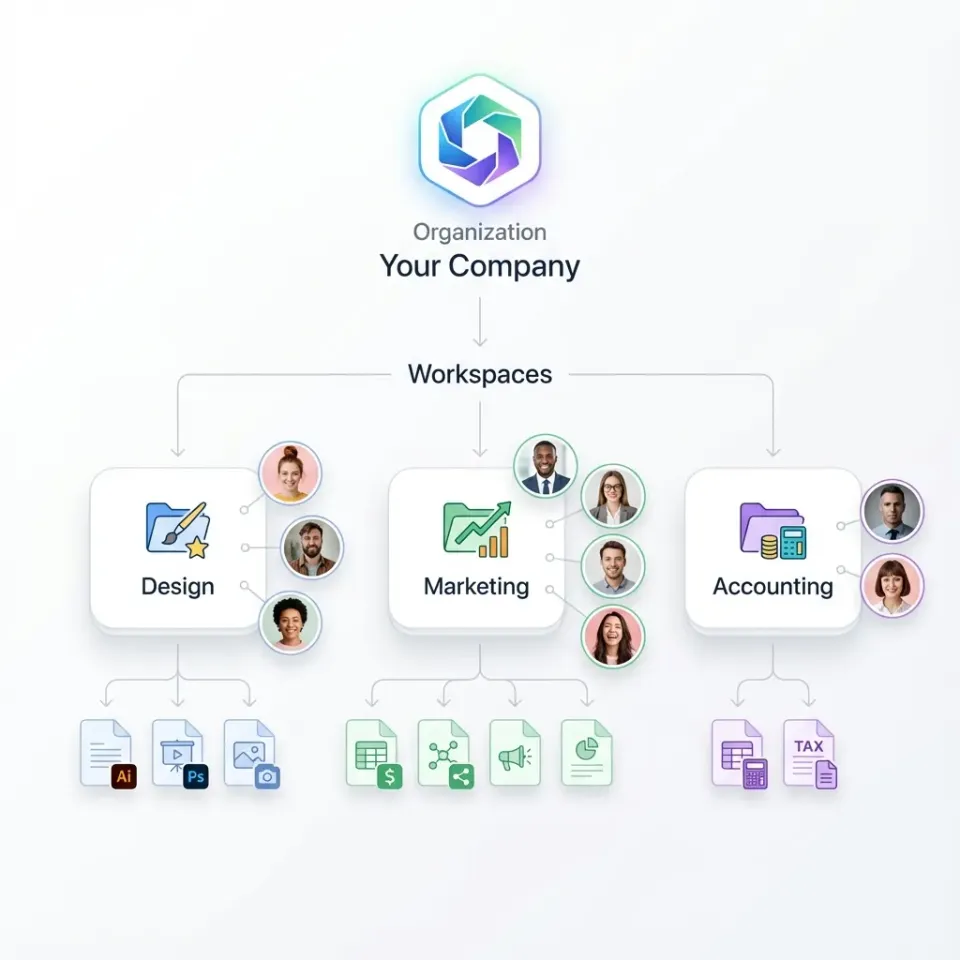
- Role-Based Access Controls (RBAC): Privileges must be structured across clear organizational boundaries. In modern legal workspaces, permissions are established at the organization, workspace, and share levels through member roles. Every participant operates under explicit permissions that govern administrative control, file editing, and external distribution.
- Global Metadata Indexing: Legal professionals rarely search by storage path alone. A legal repository must index files across three distinct dimensions: relational matter attributes (such as matter numbers, client codes, and filing dates), full-text document content, and semantic meaning. Decoupled search indices process file contents in background queues so search queries return instantaneous results across vast matter archives.
- Enterprise Directory and Identity Integration: Centralized user identity management keeps access privileges synchronized with human resources directories. User provisioning through SCIM (System for Cross-domain Identity Management) automates onboarding and offboarding. When an attorney or paralegal leaves the firm or shifts practice groups, access to confidential matter repositories updates immediately.
By separating these responsibilities into distinct architectural layers, legal IT teams prevent single points of congestion. When large discovery bundles or scanned contracts enter the storage fabric, asynchronous event queues decouple document ingestion from extraction workloads. Background workers process file parsing, text extraction, and full-text tokenization without holding client connections open or throttling database writes. The binary storage fabric expands elastically as evidentiary collections grow, while the metadata and search engines scale independently to serve concurrent attorney queries across global offices.
Data Models and Matter-Centric Taxonomies at Scale
The core organizational construct of corporate legal work is the matter. Unlike general enterprise document management, where files are organized by corporate department or project phase, a legal EDMS must enforce a matter-centric taxonomy. Every contract, disclosure, motion, and correspondence belongs to a defined client matter.
Relational Metadata vs. Binary Storage
In early-generation legal software, developers often stored document files as BLOBs (Binary Large Objects) directly within database rows alongside matter records. While this maintained tight transactional coupling, it caused database sizes to expand uncontrollably. Database maintenance routines like re-indexing, defragmentation, and point-in-time recovery became virtually impossible to execute within reasonable maintenance windows.
Modern legal architecture strictly separates the system of record from binary storage. The relational database stores matter identifiers, client metadata, author records, and file version trees. When a user uploads a brief, the binary payload routes directly to distributed object storage, returning a content-addressed hash or unique identifier. The relational database records this pointer. If the document is revised, the system writes a new binary object and creates a new version record linked to the parent file.
Matter Taxonomy and Lifecycle Transitions
A well-structured legal taxonomy reflects the progression of legal work across distinct stages. When structuring matter workspaces, enterprise legal operations teams establish standard directory tiers:
- Pleadings and Filings: Formal court submissions, verified complaints, answers, and docket records.
- Discovery and Evidentiary Productions: Inbound and outbound document productions, interrogatory responses, and deposition transcripts.
- Work Product and Research: Internal legal memoranda, strategy outlines, and draft motions.
- Closing Documents and Executed Agreements: Final signed agreements, corporate resolutions, and regulatory consents.
As matters conclude, workspaces transition through lifecycle states. Active workspaces support frequent collaborative modifications and external deliveries. Once litigation resolves or transactions close, workspaces shift into read-only retention states, preserving files for corporate compliance while preventing unauthorized revisions.
Advisory File Locking and Version Integrity
Transactional legal drafting involves rapid iterations between in-house counsel, associate attorneys, and outside partners. If two attorneys edit a master credit agreement simultaneously, conflicting overwrites can erase critical negotiated revisions.
Legacy document systems addressed this with rigid checkout models: when an attorney opened a document, the entire file locked, preventing colleagues from viewing or editing until manual check-in. In modern collaborative environments, this creates severe workflow bottlenecks.
A scalable EDMS replaces rigid checkouts with advisory file leases paired with per-file version history. An advisory lease allows an attorney or automated process to signal active editing. Other team members can see who holds the lease, while concurrent writes land safely as new revisions in the version history. If an unintended change occurs, legal operations leads can inspect earlier versions and restore the correct revision.
Transforming Unstructured Documents with Metadata Views
A persistent challenge in enterprise legal document management is extracting structured intelligence from unstructured matter archives. Corporate legal departments store vast collections of executed contracts, lease agreements, and regulatory filings whose contents remain locked in static PDF pages.
Fastio resolves this through Metadata Views, which turn static document repositories into live, queryable data grids. Legal teams define the structured fields they need to track, such as counterparty names, effective dates, termination notice windows, governing law, and indemnification caps.
Metadata Views automatically analyze documents in the workspace, generating a typed schema supporting Text, Integer, Decimal, Boolean, URL, JSON, and Date & Time values. Because the extraction engine operates without rigid OCR templates, it processes complex legal formats including native PDFs, scanned exhibits, and Word documents. Legal operations leads can add new metadata columns at any time without reprocessing the underlying files, enabling cross-matter contract analysis.


Modernize Corporate Legal Matter Delivery
Replace cumbersome legal extranets and email attachments with secure, branded matter workspaces. Features include per-file version history, a detailed activity log of changes, and structured document data extraction. Monthly plans start with a 14-day free trial that requires a credit card, with plans starting at $9.99/mo for Starter, $49.99/mo for Business, and $199.99/mo for Enterprise.
How Hybrid Cloud Workspaces Bridge the Monolithic Delivery Gap
One of the most persistent failures of traditional enterprise document management systems is external collaboration. Traditional platforms like legacy deployments of iManage, NetDocuments, or OpenText were engineered primarily as internal document vaults. Expanding these systems to include external stakeholders, such as co-counsel, expert witnesses, forensic investigators, and corporate executives, introduces significant administrative friction.
External participants often struggle with complex client network tunnels, specialized desktop client installations, and rigid account creation procedures. According to the American Bar Association, 53% of survey respondents reported that their firm does not offer clients access to a secure client portal. When internal systems make secure file exchange difficult, attorneys and clients frequently revert to unencrypted email attachments or unmanaged consumer cloud drives, violating corporate data governance policies.
[ Internal Legal Repository (System of Record) ]
                        │
                        ▼
      [ Automated Matter Provisioning API ]
                        │
                        ▼
[ Agile Cloud Matter Workspace (System of Engagement) ]
   ├── Branded Content Portals (Client Document Review)
   ├── Durable File Shares (Discovery & Exhibit Delivery)
   └── Receive Shares (Secure Inbound Document Collection)
Modern legal operations teams solve this by pairing their internal system of record with agile cloud workspaces designed specifically for matter delivery. Instead of inviting outside counsel into internal document repositories, the firm provisions dedicated, branded matter workspaces.
Scoped Shares and Granular Delivery Controls
When exchanging sensitive legal materials, legal teams require precise control over distribution. Through Fastio branded portals and File Shares, corporate legal departments can share specific matter folders or document bundles with external parties without exposing adjacent legal records.
Key delivery controls include:
- Durable and Expiring Shares: Teams can establish durable shares for long-term litigation matters or configure shares with automatic expiration dates for transactional closings.
- Download Restrictions: For proprietary disclosures, settlement drafts, or trade secret exhibits, legal administrators can disable file downloads, allowing external parties to review documents within a secure browser viewer while preventing local saving.
- Inbound Document Collection via Receive Links: Rather than collecting sensitive corporate records, tax filings, or personnel documents through email attachments, legal teams deploy Receive shares. External parties upload files directly into the matter workspace without requiring an account or seeing other files in the directory.
Handling High-Volume Litigation Assets
Litigation discovery routinely involves massive media files that overwhelm traditional legal software. Deposition video recordings, digital forensics disk images, and voluminous audio files regularly exceed the storage and transfer thresholds of legacy document tools.
Modern matter workspaces support high-capacity file handling designed specifically for massive evidentiary collections. Large litigation assets stream directly in the browser via HLS video streaming, eliminating the need for litigators to download massive media packages to local workstations before review.
Security Governance, Auditing, and Automation in Modern Legal Operations
For corporate legal departments, data governance is an ethical and contractual imperative. Legal technology architectures must enforce strict information barriers while maintaining detailed operational visibility across all matter activities.
Enforcing Ethical Walls and Workspace Boundaries
Corporate legal teams frequently manage matters with conflicting internal interests, such as internal investigations, executive compensation reviews, or mergers involving competing business units. Modern document platforms maintain ethical walls through role-based permissions set per organization, workspace, and share.
Because permissions apply to the workspace rather than individual folders or files, legal administrators maintain absolute clarity over data access. An internal investigation workspace can be isolated to selected attorneys and outside forensic partners, ensuring that other corporate employees and general legal staff have zero visibility into matter contents.
Detailed Activity Logging for Operational Governance
Corporate legal leaders must maintain complete visibility into administrative and operational changes across their file repositories. Fastio provides a detailed activity log that records modifications across the organization, tracking file uploads, revisions, file moves, deletions, membership adjustments, permission updates, and share creation events.
This detailed activity log provides a clear record of repository changes, enabling legal operations directors to verify exactly when a disclosure package was updated or who added an outside counsel member to a matter workspace. Crucially, the activity log focuses strictly on operational and storage changes, avoiding the clutter of read-only access telemetry.
Executing Legal Agreements with Integrated E-Signatures
Contractual closing workflows often stall when documents must be exported from storage repositories, routed through separate third-party signing tools, and manually filed back into matter directories.
Fastio integrates e-signature capabilities directly into every workspace plan. Legal teams can send agreements for signature directly from the matter folder, designating signers in sequence or in parallel. Signatures can be protected with optional one-time passcodes per signer. Once all parties complete execution, the platform generates a tamper-evident audit certificate and automatically deposits the finalized agreement back into the matter workspace.
Automating Legal Workspaces via API and Remote MCP
Enterprise legal operations teams increasingly rely on programmatic automation to eliminate manual matter setup. When a new litigation matter or corporate acquisition is opened in an enterprise matter management platform, IT engineers can automatically provision a corresponding Fastio workspace using the REST API at https://api.fast.io/current/ or shell scripts using the official @vividengine/fastio-cli utility.
For teams deploying autonomous AI agents for contract triage or discovery sorting, Fastio provides remote Model Context Protocol (MCP) tooling over Streamable HTTP. Agents connect securely at https://mcp.fast.io/mcp/tools for standard client applications or https://mcp.fast.io/mcp/code for coding agents. Using scoped authentication, AI agents can read and write files directly within designated matter workspaces, enabling automated document organization and metadata tagging without compromising broader corporate security boundaries.
Sources
References used to verify factual claims in this guide.
-
According to the American Bar Association, 53% of survey respondents reported that their firm does not offer clients access to a secure client portal.
Frequently Asked Questions
What is an enterprise document management system?
An enterprise document management system (EDMS) is a large-scale software platform designed to manage the creation, storage, compliance, and retrieval of vast document repositories across complex organizational units. In corporate legal departments, an EDMS provides matter-centric organization, version control, role-based access governance, and metadata search across litigation, contract, and compliance documents.
How much does an enterprise document management system cost?
Legacy on-premises legal document management systems require substantial capital outlays for server hardware, relational database licenses, and ongoing maintenance retainers, alongside recurring per-seat subscription fees. In contrast, modern cloud workspaces eliminate dedicated hardware and database licensing costs through predictable subscription tiers based on seats and workspace capacity, with monthly plans beginning with a 14-day free trial that requires a credit card.
What are key features of enterprise legal document management?
Key features include matter-centric folder hierarchies, role-based access controls at organization, workspace, and share levels, per-file version history, advisory file locking, global metadata indexing, full-text search, and a detailed activity log of repository changes. Modern systems also provide branded client portals, structured data extraction, and integrated e-signatures.
How does an enterprise legal document management system differ from consumer cloud storage?
Consumer cloud storage organizes files in simple personal folder structures without matter context, detailed change logs, or legal-specific metadata. An enterprise legal EDMS enforces matter-centric taxonomies, maintains ethical walls between conflicting practice areas, tracks per-file version histories, supports large evidentiary media files, and provides structured metadata extraction across unstructured documents.
How do corporate legal teams handle large discovery files and deposition video?
Corporate legal teams handle massive discovery files and deposition video by adopting high-capacity cloud workspaces that decouple binary storage from database records. Modern workspaces support large file transfers alongside browser-based HLS streaming for deposition video, allowing counsel to review media without local downloading.
Related Resources

Modernize Corporate Legal Matter Delivery
Replace cumbersome legal extranets and email attachments with secure, branded matter workspaces. Features include per-file version history, a detailed activity log of changes, and structured document data extraction. Monthly plans start with a 14-day free trial that requires a credit card, with plans starting at $9.99/mo for Starter, $49.99/mo for Business, and $199.99/mo for Enterprise.