8 Best ChatGPT Detector Tools in 2026
GPTZero reported 99.5% accuracy when it re-ran a benchmark published by University of Chicago Booth researchers, while a March 2026 Kinja roundup of independent tests put its accuracy between 62% and 88%. That gap between lab benchmarks and actual writing defines AI text detection in 2026. This guide compares 8 ChatGPT detector tools by their documented features, free limits, and pricing, explains where every classifier fails, and shows how to use detection reports in an editorial workflow.


Why ChatGPT Detection Keeps Getting Harder
GPTZero, one of the most widely used AI detectors, reported 99.5% accuracy when it re-ran a benchmark published by University of Chicago Booth researchers. That dataset paired human-written excerpts with AI rewrites of the same passages from several current models. A March 2026 Kinja roundup of independent tests put GPTZero's accuracy between 62% and 88%. That gap between controlled lab conditions and everyday writing defines the state of ChatGPT detection in 2026.
ChatGPT detectors work by measuring statistical patterns in text. The two signals most tools rely on are perplexity (how predictable each word choice is) and burstiness (how much sentence length and structure varies throughout a passage). Human writers produce text with higher perplexity and more burstiness. People go on tangents, write a three-word sentence followed by a forty-word one, and pick unusual words when a common synonym would do.
ChatGPT optimizes for coherent, predictable output. Its sentences cluster around similar lengths, and its vocabulary leans toward common choices. Those patterns give classifiers something to measure, and they worked well against earlier models. Each new model release narrows the gap.
GPT-3.5 text is the easiest to catch because its output is the most formulaic. GPT-4o and GPT-4.5 write with more natural variation, bringing their statistical profile closer to human writing. How each tool measures those patterns matters more than any single headline score.
OpenAI tried building its own AI text classifier and shut it down in July 2023 after six months, citing a low rate of accuracy (as reported by TechCrunch) because it could not reliably distinguish model output from human writing. Third-party tools have added sentence-level highlighting, batch scanning, and plagiarism checks since then, but the underlying statistical challenge remains.
Related guides
- Best AI Image Detectors in 2026: How to Spot AI-Generated ImagesOver 80 million AI-generated images appear online every day, and most people cannot tell them apart from photographs....
- Best Free AI Detectors in 2026: No-Cost Tools That Actually WorkIndependent benchmarks in 2026 found that average AI detector accuracy is 85.7% on standard text but drops 15 to 30...
- Hive Moderation AI Detector Review for 2026A University of Chicago study found Hive Moderation's image detection hit 98.03% accuracy with a 0% false positive...
- Winston AI Detector Review for 2026: What Independent Tests ShowUniversity of Florida researchers tested Winston AI against academic text and measured 75.9% detection accuracy,...
- Scribbr AI Detector Review for 2026: Accuracy, Pricing, and AlternativesThe Axis Intelligence January 2026 benchmark tested 10 AI detectors across 600 text samples and placed Scribbr at 72.8%...
- Best AI Humanizer Tools in 2026: 8 Options Tested and RankedAI humanizers rewrite machine-generated text to read more naturally and pass detection tools. We tested eight popular...
More on this subject: AI Detection and Text Tools (28 guides)
8 ChatGPT Detector Tools Compared
Here are 8 AI detectors available in 2026, compared by their documented features, free limits, and pricing. The tools below are numbered for reference; the numbering is not a ranking.
- GPTZero: sentence-level probability highlighting and classroom integrations for education
- Originality.ai: AI detection bundled with plagiarism, readability, and SEO tools for publishers
- Winston AI: downloadable PDF reports with confidence breakdowns for agencies
- Copyleaks: Canvas, Moodle, and Blackboard integrations with broad language support
- Grammarly AI Detector: free basic AI checks with no signup from an established writing platform
- ZeroGPT: free scans of up to 15,000 characters with no signup required
- QuillBot AI Detector: free scans under 1,200 words alongside paraphrasing and writing tools
- Quetext: plagiarism checking and AI detection in one tool, with a free tier up to 1,000 words
1. GPTZero
GPTZero says it is trusted by over 10 million teachers and students. It reported 99.5% accuracy when it re-ran a benchmark published by University of Chicago Booth researchers, while a March 2026 Kinja roundup of independent tests put its accuracy between 62% and 88%.
Like other statistical classifiers, it flags unedited ChatGPT output far more consistently than drafts that a human writer has revised to vary word choices and sentence structure.
The free plan covers 10,000 words a month; Premium is $12.99 a month billed annually for 300,000 words, and Professional is $24.99 a month billed annually for 500,000 words. GPTZero highlights individual sentences by AI probability and provides document-level confidence scores. Education features include batch scanning and classroom integrations.
Best for: educators and institutions that need high-volume scanning with detailed per-sentence breakdowns.
2. Originality.ai
Originality.ai targets publishers and content teams. It bundles AI detection with plagiarism checking, readability scoring, fact-checking, and an SEO content optimizer. Sentence-level highlighting shows which passages the classifier flagged, with individual confidence scores for each.
Detection rates depend on which model wrote the draft, and newer models are generally harder to catch.
On monthly billing, pricing starts at $14.95/month for 2,000 credits (one credit covers 100 words). Extra credits can be bought one time, and API access comes with the Enterprise plan.
Best for: content agencies and publishers who need AI detection alongside plagiarism and readability checks in one dashboard.
3. Winston AI
Winston AI is an AI detector built for agencies, publishers, and educators. It analyzes text for patterns from ChatGPT, GPT-4, DeepSeek, and Claude, though like other statistical detectors it can miss heavily edited text or output from newer models and can flag formulaic human prose.
Winston generates shareable PDF reports with confidence breakdowns. It also includes plagiarism detection and readability scoring in the same package.
Essential costs $18 a month for 100,000 credits (one credit per word for AI detection), and Advanced costs $29 a month for 200,000 credits.
Best for: agencies and content teams that need shareable PDF detection reports for client deliverables.
4. Copyleaks
Copyleaks built its reputation on plagiarism detection and expanded into AI content detection. It connects to Canvas, Moodle, and Blackboard, fitting into grading systems that schools and universities already run.
Like other classifiers, it is less reliable on paraphrased or heavily edited text. Where Copyleaks stands out is multilingual coverage, supporting 30+ languages for AI detection and 100+ for plagiarism checks.
The Personal plan costs $13.99 a month billed annually for up to 300,000 words a year. Education and enterprise plans use per-seat pricing with custom contracts. The free detector scans up to 25,000 characters without an account.
Best for: schools and universities that want AI detection built into their existing LMS without requiring students or faculty to open a separate tool.
5. Grammarly AI Detector
Grammarly offers its AI detector as a free web tool that requires no signup. The free detector shows what percentage of a text appears AI-generated, for up to 25,000 characters. Grammarly Pro ($12 a month) adds the AI Detector agent, which shows which phrases may read as AI-generated.
False positives remain a concern on formal or structured human prose. Grammarly's own documentation notes that no AI detector is 100% accurate and advises against treating detector scores as sole proof.
The advantage here is convenience. Many writers and editors already use Grammarly, and the interface is straightforward.
Best for: individual writers who want a quick, free check from a writing tool they already use.
6. ZeroGPT
ZeroGPT offers free scans with no signup required, making it one of the most accessible tools in this comparison. The free detector checks up to 15,000 characters per scan. Paid plans start at $8.99 a month billed annually and add batch checks and PDF reports.
As with every detector, false positives are a recurring tradeoff, particularly on formal human writing and essays written by non-native English speakers.
ZeroGPT has expanded into a broader tool suite that includes an AI humanizer, image detector, plagiarism checker, and paraphraser. Its detection model scores text across statistical dimensions using a multi-stage classifier.
Best for: anyone who wants quick free scans of short texts.
7. QuillBot AI Detector
QuillBot's AI detector is a free companion to its paraphrasing and grammar tools. It is free with no signup for scans under 1,200 words; Premium ($8.33 a month billed annually) gives full access.
Scribbr, which shares a parent company with QuillBot, scored QuillBot's free detector at 78% in its own comparison.
QuillBot works well as a second-opinion check. If you already use another detector such as GPTZero or Originality.ai, running a flagged passage through QuillBot gives you a quick comparison without adding much cost.
Best for: budget-conscious users who want a secondary detection check alongside their primary tool.
8. Quetext
Quetext (from Quetext Software LLC) is a long-running plagiarism checker that also offers an AI content detector. Quetext says it has helped more than 10 million students, teachers, and professionals.
Quetext includes a free tier where the AI detector checks up to 1,000 words, and basic checks do not require signing up. Paid plans start at $8.25 a month billed yearly ($14.99 month to month). A Chrome extension is available for checking text in the browser.
Best for: writers, students, and educators who want plagiarism checking and AI detection in one tool.
Where Every ChatGPT Detector Fails
No detector is reliable enough to serve as the sole basis for accusing someone of using AI. Three failure modes affect every tool in this comparison.
Edited and humanized text lowers detection rates. When a human rewrites AI output by changing word choices, varying sentence length, and restructuring transitions, the statistical patterns that classifiers look for break down. Even tools that consistently flag raw ChatGPT output often miss drafts that a writer has substantially revised.
Non-native English speakers face high false positive rates. A 2023 Stanford study found that AI detectors classified 61% of TOEFL essays written by non-native English students as AI-generated. Second-language writers often use more direct vocabulary and repeatable sentence structures, which overlap with the low-perplexity signals detectors use to identify AI text. Any organization using these tools in a multilingual environment needs to account for this bias.
Newer GPT models are harder to catch. Detection sensitivity varies sharply by model generation. GPT-3.5 output is the easiest to flag because its phrasing is the most repetitive, while GPT-4o and GPT-4.5 produce more natural variation. As language models improve, the statistical gap between AI writing and human writing narrows.
How to Choose the Right ChatGPT Detector
The right detector depends on how your team reviews writing and which tools you already use.
For education: GPTZero or Copyleaks. GPTZero provides sentence-level probability highlighting and batch scanning for classrooms. Copyleaks fits schools that already run Canvas, Moodle, or Blackboard and want detection built into existing grading workflows.
For publishing and content teams: Originality.ai or Winston AI. Originality bundles AI detection with plagiarism and readability tools in one credit-based dashboard. Winston generates downloadable PDF reports you can share with clients alongside finished deliverables.
For combined plagiarism and AI checks on a budget: Quetext. Its free tier checks up to 1,000 words without requiring an account for basic checks. Paid plans start at $8.25 a month billed yearly ($14.99 month to month), and a Chrome extension is available.
For individual writers: Grammarly, ZeroGPT, or QuillBot. All three offer free checks. Grammarly and ZeroGPT require no signup for basic scans, and QuillBot is free with no signup for scans under 1,200 words.
For API integration: Originality.ai (Enterprise plan), GPTZero, and ZeroGPT offer API access for teams that want to build detection into automated content pipelines.
One principle applies across all 8 tools: never rely on a single detector. Run questionable passages through at least two classifiers before drawing conclusions. A draft that two independent detectors flag at high confidence warrants a closer editorial look than one that triggers a borderline score in a single tool.
Building Detection Into Your Content Workflow
Treating detection as an occasional spot check leads to inconsistent decisions. If your team produces or reviews AI-assisted writing regularly, detection works best as a documented step in your editorial process.
Start by setting clear rules for how editors interpret scores. A borderline probability reading from one tool carries far less weight than a high-confidence flag confirmed across two independent detectors. Decide in advance when a flagged draft goes back to the writer for revision or source verification, before you begin scanning.
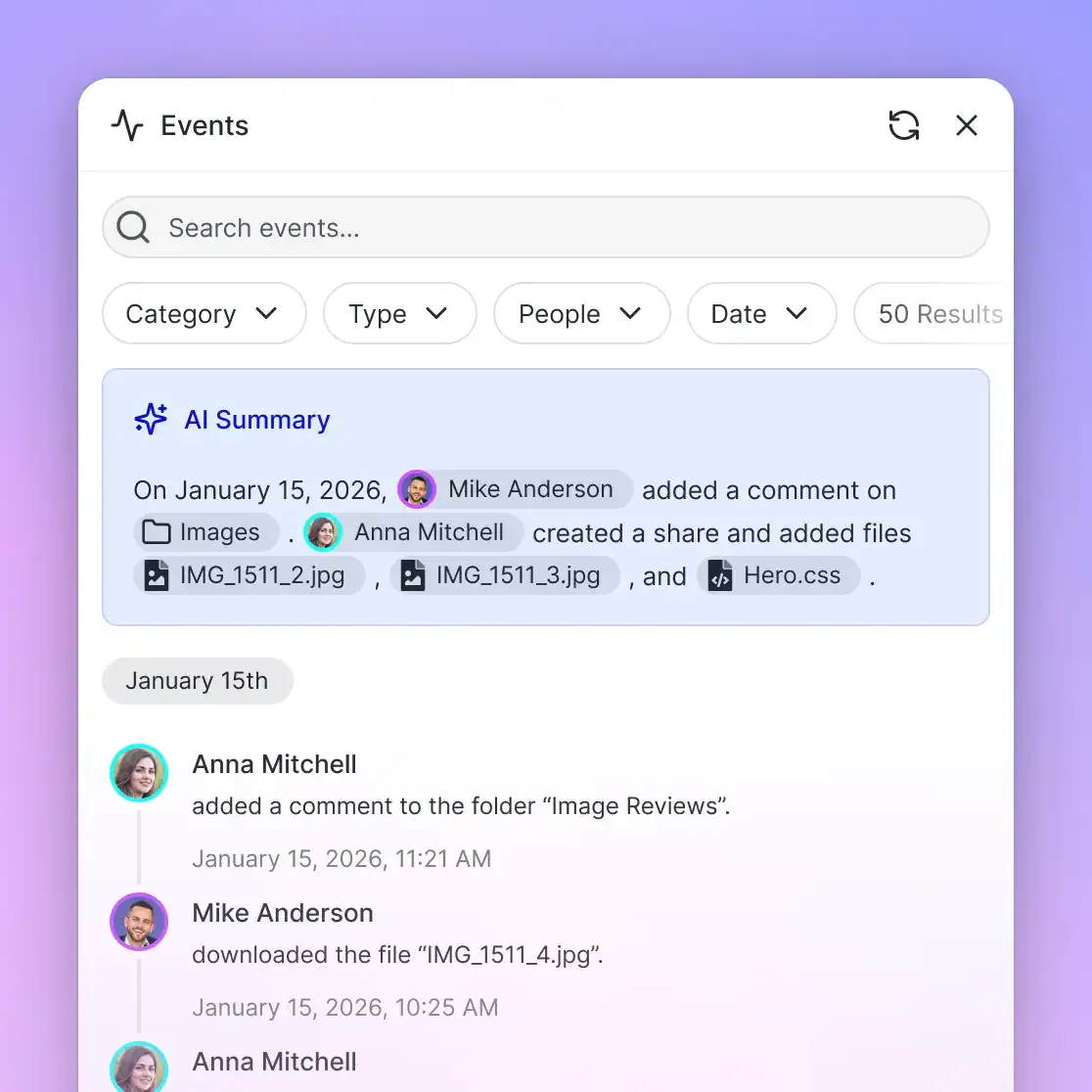
Keep records of every scan. When you run a draft through a detector, save the results alongside the document for client deliverables, academic reviews, or internal audits. In Fastio, teams can store drafts and PDF detection reports in the same workspace with per-file version history, anchored comments for editorial feedback, and a detailed activity log of changes.
Finally, pair automated classifiers with human editorial judgment. AI detectors measure word predictability and sentence length variation. Experienced editors catch what statistical detectors miss: unverified claims, missing context, and generic phrasing that reads smoothly without saying anything specific.
Sources
References used to verify factual claims in this guide.
-
GPTZero reported 99.5% accuracy when it re-ran a benchmark published by University of Chicago Booth researchers
-
A March 2026 Kinja roundup of independent tests put GPTZero's accuracy between 62% and 88%
-
OpenAI shut down its AI text classifier in July 2023 citing a low rate of accuracy
-
A 2023 Stanford study found that AI detectors classified 61% of TOEFL essays written by non-native English students as AI-generated
-
GPTZero's free plan covers 10,000 words a month; Premium is $12.99 a month billed annually for 300,000 words, and Professional is $24.99 a month billed annually for 500,000 words
-
On monthly billing, Originality.ai pricing starts at $14.95 a month for 2,000 credits, with one credit covering 100 words
-
Winston AI Essential costs $18 a month for 100,000 credits, and Advanced costs $29 a month for 200,000 credits
-
The Copyleaks Personal plan costs $13.99 a month billed annually for up to 300,000 words a year
-
The free Copyleaks AI detector scans up to 25,000 characters without an account
-
Grammarly Pro costs $12 a month
-
ZeroGPT paid plans start at $8.99 a month billed annually, and the free detector checks up to 15,000 characters per scan
-
QuillBot Premium costs $8.33 a month billed annually
-
QuillBot's AI detector is free with no signup for scans under 1,200 words
-
Scribbr, which shares a parent company with QuillBot, scored QuillBot's free detector at 78% in its own comparison
Frequently Asked Questions
What is the best ChatGPT detector?
The right tool depends on your use case. GPTZero and Copyleaks focus on education with classroom and LMS integrations. Originality.ai and Winston AI are built for publishers and agencies that need credit-based scanning or downloadable PDF reports. Quetext combines plagiarism checking and AI detection with a free tier up to 1,000 words; paid plans start at $8.25 a month billed yearly ($14.99 month to month). Grammarly, ZeroGPT, and QuillBot offer free checks for individual writers. Running text through two detectors is more reliable than trusting one.
Can AI detectors tell if you used ChatGPT?
Detectors can often flag unedited ChatGPT output, but detection rates drop once a human rewrites sentences and varies word choices. Because these tools measure statistical patterns such as word predictability and sentence variation rather than a hidden watermark, they estimate probability and cannot prove with certainty that ChatGPT was used.
Is there a free ChatGPT detector?
Yes. ZeroGPT checks up to 15,000 characters per scan for free with no signup, and Grammarly's free detector checks up to 25,000 characters. Quetext checks up to 1,000 words on its free tier with no signup required for basic checks. QuillBot is free with no signup for scans under 1,200 words, Copyleaks scans up to 25,000 characters without an account, and GPTZero covers 10,000 words a month for free.
How accurate are ChatGPT detectors?
Accuracy varies widely between controlled vendor benchmarks and everyday writing. GPTZero reported 99.5% accuracy when it re-ran a benchmark published by University of Chicago Booth researchers, while a March 2026 Kinja roundup of independent tests put its accuracy between 62% and 88%. Scribbr, which shares a parent company with QuillBot, scored QuillBot's free detector at 78% in its own comparison. Accuracy falls on human-edited drafts, and false positives remain common.
Why did OpenAI shut down its AI text classifier?
OpenAI discontinued its classifier in July 2023 after six months, citing a low rate of accuracy. The tool could not reliably distinguish between human and AI-generated text, and it frequently mislabeled writing from non-native English speakers. No replacement has been announced.
Do AI detectors work on GPT-4o and newer models?
Newer models such as GPT-4o and GPT-4.5 produce more varied sentence structures and vocabulary than GPT-3.5, making their output harder for statistical classifiers to catch. As language models generate more natural variation, detectors become less reliable.
Can AI detectors flag human writing by mistake?
Yes. Every statistical AI detector can produce false positives on human writing, especially when the prose is formal, structured, or written by non-native English speakers. A 2023 Stanford study found that AI detectors classified 61% of TOEFL essays written by non-native English students as AI-generated. Simpler vocabulary and predictable sentence structures overlap with the patterns classifiers score.